
Case facts
- Client type
- Established restaurant
- Assignment
- Menu optimisation, upselling and improved service flow
- Services
- Menu development, table planning, ticket configuration and operational optimisation
The challenge
The menu lacked a clear structure for small, standalone sharing dishes. Customers were unsure how many dishes to choose and how to compose a meal, limiting both upselling and repeat orders.
At the same time, the table numbering was difficult for staff to navigate. The kitchen tickets contained the necessary information, but their layout made them slow to interpret. Allergens and special requests could disappear among the other text when service was busy.
What we found
Three parts of the operation had to be addressed together:
- The menu needed to make the small, standalone sharing dishes easy to understand and combine.
- The table numbers needed to be faster and more intuitive to interpret.
- The kitchen tickets needed to display the most important information immediately.
Changing the menu alone would have left the service and kitchen problems unresolved. The entire flow from order to service therefore had to be considered as one process.
What we implemented
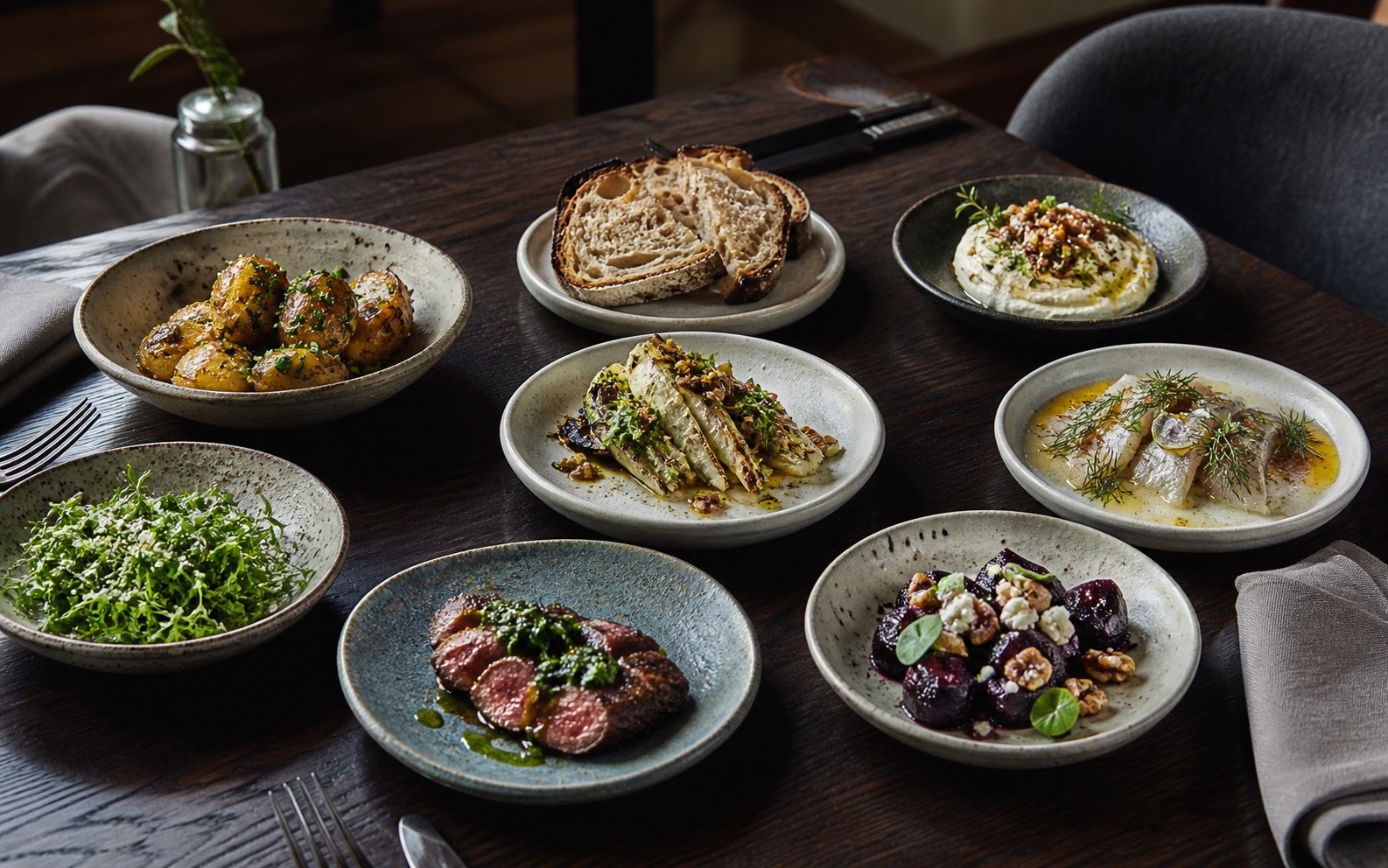
The menu was rebuilt around small, standalone sharing dishes that could be ordered individually or shared. The dishes were grouped clearly and supported by guidance on how many to choose per person, making the decision easier and creating a natural reason to order another round.
The table numbers were reorganised into a simpler, more logical system, enabling front-of-house staff to find their way around the restaurant more quickly.
The kitchen tickets were redesigned to present information in the order the kitchen needed it. Allergens and special modifications were highlighted in capital letters with clear visual markers.
The objective was simple: the kitchen should be able to understand a ticket in around two seconds without having to search for critical information.
Highlighted result
The result
Following the change, the restaurant saw an increase in revenue. The clearer small-plates structure made it easier for customers to compose their meal, share several dishes and order an additional round.
The operational changes also delivered:
- A clearer table plan.
- Faster communication between front of house and the kitchen.
- Kitchen tickets that could be interpreted in seconds.
- Clearer labelling of allergens and special requests.
- Less need for verbal clarification during service.
- A better flow from order to service.
The case shows that menu development is not only about the dishes. Sales, table planning, communication and the kitchen's working tools must operate as one integrated solution.