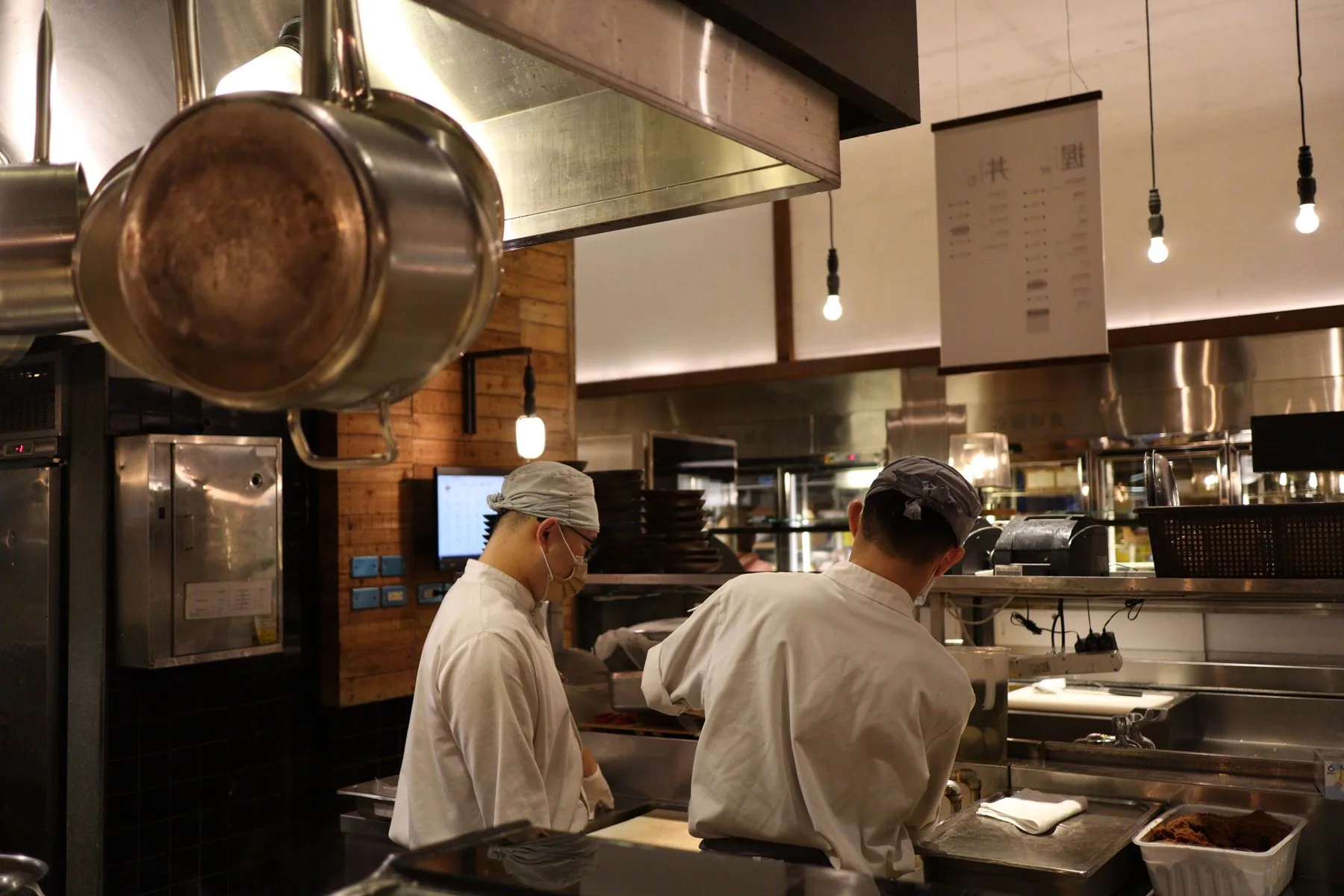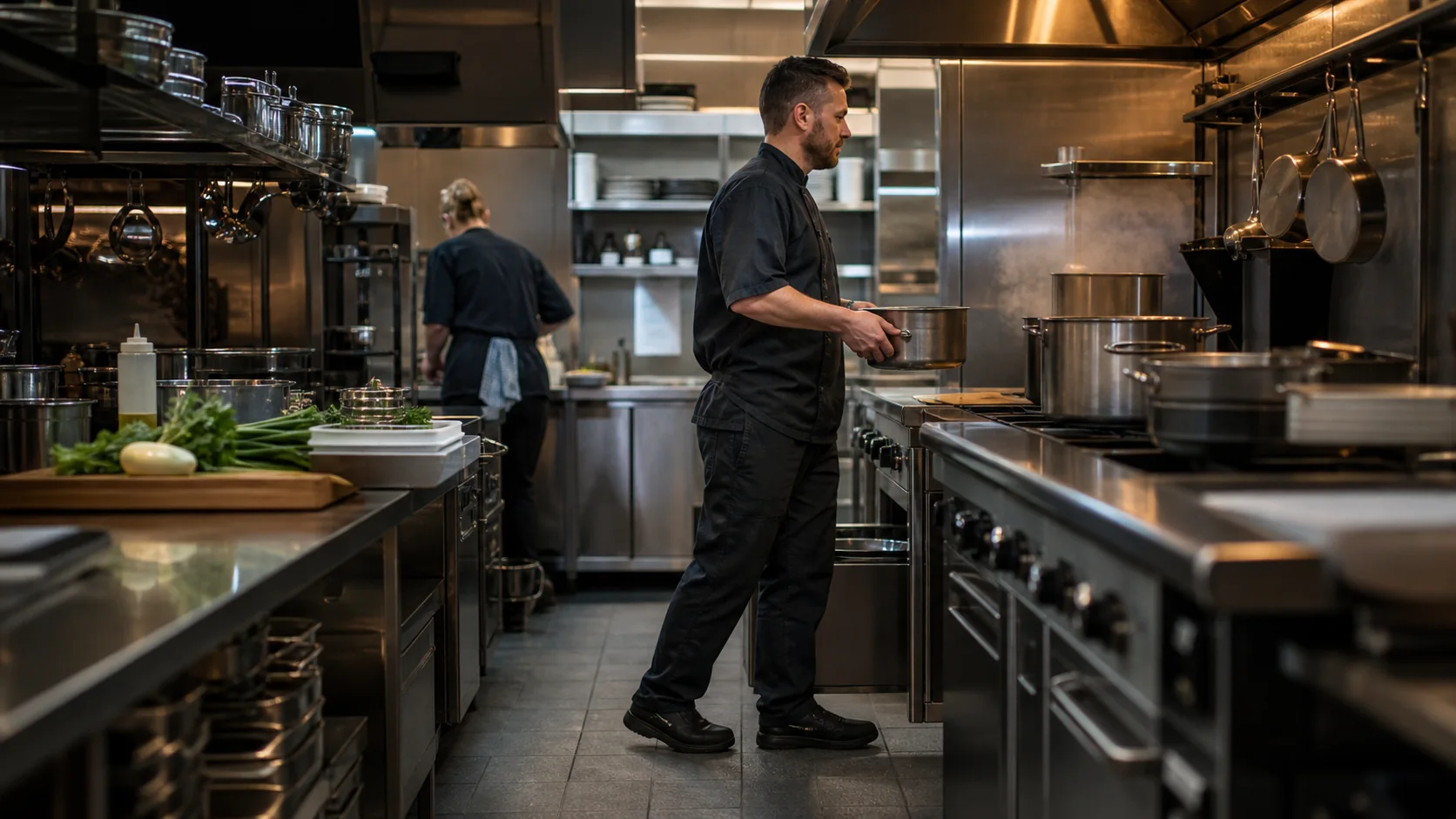
A restaurant kitchen is full of boiling liquids, hot oil, sharp knives, slippery floors and heavy pots. Yet the industry has no fixed limits for factors such as temperature, space, workwear or slip-resistant footwear. Employers are expected to decide for themselves what is safe – and often receive a definitive answer only after an enforcement notice or workplace accident.
Can a chef work in flip-flops and shorts?
How hot can it be in front of the range? Is 35°C acceptable? What about 45°C or 55°C?
How narrow can the passage between the deep fryer and the workbench be? How large a pot can safely sit on a small hob? And can an oven be installed at knee height if an employee has to remove trays of food at 200°C?
You might expect clear answers to such routine questions. Often, there are none.
Restaurant kitchens are not unregulated. Danish health and safety rules require work to be carried out in a way that is fully safe and healthy. The problem is that the rules rarely tell a restaurant owner exactly where the line is drawn.
The rules define the objective – not the limit
The current Danish Executive Order on the Design of Permanent Workplaces requires, among other things, that a workplace provide sufficient space, that floors have suitable slip resistance and that the temperature be appropriate for the human body.
It also states that hazards caused by factors such as extreme temperatures must be minimised as far as possible, and that the workplace must be designed so that work can be carried out safely.
These provisions are binding. But what do they mean in a real restaurant kitchen?
- How many centimetres count as “sufficient space”?
- What slip-resistance rating is “suitable”?
- What temperature is appropriate for the body during a busy service?
- When is an oven positioned unsafely?
- When does the risk require protective clothing or footwear?
There is no single kitchen standard that provides the answers. Read the Danish Executive Order on the Design of Permanent Workplaces.
Denmark has chosen to regulate through what are known as performance requirements. The rules describe the safety outcome an employer must achieve, but not necessarily the precise technical solution required.
That allows for flexibility. A hotel kitchen, a basement restaurant and a street-food stall cannot all be designed in the same way. But this flexibility also means that the owner must initially decide whether the working conditions are safe.
The risk is not theoretical
In the Danish Working Environment Authority’s 2021 national monitoring survey, 16.5 per cent of employees in restaurants and bars said they had experienced at least one workplace accident during the previous year. This was the highest proportion among the survey’s 38 industry groups.
The figure is based on employees’ own responses and cannot be compared directly with the number of workplace accidents formally reported. Even so, it shows that injuries are not rare exceptions. Read the Danish Working Environment Authority’s NOA-L survey.
The Authority’s own workplace assessment checklist for restaurants asks, among other things, whether employees are at risk of slipping, cutting or burning themselves, or of being physically strained by large pots and heavy lifting.
The checklist helps businesses ask the right questions. It simply does not provide a binding answer.
Can you work in flip-flops and shorts?
There is no general rule in Denmark requiring every employee in a commercial kitchen to wear closed, secure-fitting, slip-resistant shoes.
Nor is there a single rule prohibiting shorts, short-sleeved T-shirts, sandals or flip-flops during ordinary kitchen work.
That does not mean flip-flops are automatically safe. It means, once again, that the answer depends on a specific risk assessment.
The Danish Executive Order on the Use of Personal Protective Equipment distinguishes between ordinary workwear and equipment designed to protect an employee against a specific risk. As a general rule, ordinary workwear and uniforms are not covered by the regulations on personal protective equipment.
If the work cannot be carried out safely by other means, the employer must ensure that the employee uses the necessary protective equipment. This may include safety footwear, heat-resistant gloves, cut-resistant gloves, an apron or other protective clothing. Read the Danish Executive Order on the Use of Personal Protective Equipment.
But the Executive Order does not tell a restaurant:
- when slip-resistant footwear becomes mandatory
- what level of slip resistance the footwear must provide
- when closed footwear is necessary
- when legs must be protected against boiling liquids
- which tasks require heat-resistant gloves or a protective apron
- when cut-resistant gloves must be used
The employer must assess the risk. This gives the person responsible for paying for the equipment and enforcing its use a central role in deciding whether the equipment is needed at all.
The Danish Working Environment Authority recognises the problem with kitchen footwear
The Danish Working Environment Authority’s former guidance on safety footwear explicitly stated that shoes with slip-resistant soles may be necessary in kitchens and food production.
The guidance also explained that the risk of slipping depends on the combination of the floor surface and the sole of the shoe. In other words, it recognised the specific risk present in kitchens but stopped short of making slip-resistant footwear a general requirement across the restaurant industry. The guidance has since been archived as part of the Authority’s restructuring of its guidance materials. Read the former guidance on safety footwear.
This is where the problem becomes clear:
The risk is known. The solution is known. But no threshold has been established for when that solution becomes mandatory in restaurant kitchens.
An employee can therefore work in shoes with no documented slip-resistant properties until the business or the Danish Working Environment Authority decides that the specific risk makes safety footwear necessary.
Should workwear be subject to fixed requirements?
There is no need to require the same traditional chef’s uniform in every kitchen. Long sleeves do not automatically protect against every burn, and unsuitable clothing can trap hot liquid against the skin. Workwear must be appropriate for the task.
But there should be a clear minimum safety standard.
It is difficult to explain why an employee can work among deep fryers, boiling water, knives and greasy floors without a general requirement for closed, slip-resistant footwear. It is equally difficult to explain why there are no task-specific minimum requirements for protection when handling large quantities of hot oil and boiling liquids.
The rules do not need to dictate the colour of a chef’s jacket. They need to define the minimum protection to which an employee is entitled.
How hot can a kitchen be?
The rules on temperature reveal the same problem.
The Danish Working Environment Authority’s guidance specifies temperature limits for low-intensity work, such as office work. Under normal conditions, the temperature in such settings should generally not exceed 25°C.
But physical work in front of ovens, ranges and deep fryers is not office work. In these settings, the guidance says that the assessment depends on the task, the intensity of the work and the specific conditions.
There is no equivalent Danish model for restaurants setting out what must happen when the temperature reaches 30°C, 35°C, 40°C or 50°C. See the Danish Working Environment Authority’s temperature guidance.
The employer must still ensure that the work is safe. But it is left to the owner to decide when ventilation, more frequent breaks, staff rotation, shorter working hours, additional staffing or a temporary shutdown becomes necessary.
If an employee says that 40°C is unsafe while the owner argues that restaurant kitchens are always hot, who is right?
The parties often receive a definitive answer only if the Danish Working Environment Authority investigates the conditions.
How little space is too little?
The Danish sector working environment council, Branchefællesskabet for Arbejdsmiljø, together with organisations including HORESTA, the Danish Chamber of Commerce, 3F and Lederne, has produced guidance on restaurant kitchens. It recommends distances of 1.1 metres around workstations and 1.8 metres between opposing workstations. See the industry guidance on kitchen design.
These are useful measurements. But they are described as recommended distances rather than a binding minimum standard for every restaurant kitchen.
The industry is clearly capable of defining specific measurements. Yet the law goes no further than requiring the available space to be sufficient and safe.
This is particularly problematic in small basement restaurants, older converted retail premises and street-food stalls. Employees may work shoulder to shoulder among hot surfaces, knives, large pots and constant passing traffic.
At what point does a kitchen become unlawfully cramped?
The business may not know until the Danish Working Environment Authority has assessed that particular kitchen.
An enforcement notice becomes the first definitive answer
When the Danish Working Environment Authority carries out an inspection, it can issue an enforcement notice if the work is not considered fully safe and healthy.
Only then does the business receive a definitive answer that its own assessment was inadequate.
An enforcement notice does not always provide a complete answer as to how the problem must be solved. The Authority may require an unsafe condition to be corrected, but it cannot simply prescribe a particular method if the regulations do not provide the legal authority to do so.
At the same time, the Authority must demonstrate that the broadly worded threshold has in fact been crossed.
In one case involving physical strain, the Danish Working Environment Appeals Board overturned an enforcement notice because the Authority had not demonstrated that the work posed an unacceptable risk to health. Evidence including 302 knee bends over four hours was not sufficient. Read the decision.
In another case, an enforcement notice concerning lone working was overturned because its wording effectively required the use of an alarm. The Appeals Board found that the rules relied upon by the Authority did not provide the legal basis to require that particular solution. Read the decision.
Neither case concerns a restaurant kitchen. But they demonstrate the same weakness: when rules are broad, the Danish Working Environment Authority must define the specific threshold, prove that it has been crossed and remain within the limits of its legal powers.
The Authority’s assessment does not always stand
In 2024, the Danish Working Environment Appeals Board issued substantive decisions in 147 appeals concerning decisions by the Danish Working Environment Authority:
- 134 decisions were upheld.
- 10 were amended or overturned.
- 3 were referred back for reconsideration.
The reversal rate was therefore 9 per cent. In 2023, it was 16 per cent. The figures cover the entire field of occupational health and safety, and not every decision was reversed because of vague rules. But the statistics show that the Authority’s initial assessment does not always stand. See the Danish Working Environment Appeals Board’s annual report.
This creates a difficult arrangement:
The employer must decide in advance what is safe. The employee must work under those conditions. The Danish Working Environment Authority must subsequently prove that an unclearly defined limit has been exceeded.
It is a system that responds to specific problems. It is far less effective at telling an entire industry exactly where the line lies before someone is injured.
Does the Danish Working Environment Authority have the resources to fill the gap?
The Danish Working Environment Authority lost around 18 per cent of its full-time equivalent positions between 2014 and 2018. Its resources were subsequently strengthened through political agreements, but staffing fell again from 751 to approximately 691 full-time equivalent positions between 2023 and 2025. These figures cover the Authority as a whole and are not the same as the number of inspectors. See the Danish Working Environment Authority’s 2025 annual report.
An official response to the Danish Parliament also shows that savings planned up to 2027 were to be achieved partly through fewer full-time equivalent positions in inspection work and through a “consolidation of guidance materials”. Read the minister’s response to the Danish Parliament.
In 2025, the Authority also stated that around 180 occupational health and safety guidance documents were being reduced to 25 new guides. The purpose was partly to distinguish more clearly between binding law and good practice, and to reduce the work required to maintain the guidance. Read the Danish Working Environment Authority’s explanation.
The budget cuts are not the reason the rules were originally drafted in broad terms. That was a deliberate legal choice. But fewer resources for inspections and guidance are unlikely to make it easier to translate broad rules into practical standards.
Other countries have found specific answers
Germany also has general occupational health and safety rules, but supplements them with more specific technical standards and industry guidance.
These include:
- slip-resistance ratings for floors in restaurant kitchens
- specific guidance on closed, secure-fitting, slip-resistant footwear
- minimum dimensions for movement areas
- a temperature model with action thresholds at 26°C, 30°C and 35°C
See the German flooring standard, the kitchen standard and the temperature model.
Denmark also uses specific assessment models in other areas. When assessing lifting, for example, the Danish Working Environment Authority uses weight limits and reach distances to evaluate the physical load.
This shows that general health and safety rules can be supplemented by measurable criteria. There is no shortage of legal options. What is missing is a decision to develop a proper standard for restaurant kitchens.
The restaurant industry needs a minimum safety standard
A kitchen standard does not need to determine the colour of employees’ trousers or the position of every oven.
But it should define minimum requirements for temperature, passage widths, slip resistance, footwear and protection when working with knives, hot oil and boiling liquids.
Restaurants should remain free to choose alternative solutions if they can demonstrate that those solutions provide at least the same level of safety. What matters is that employees have a specific threshold they can rely on, restaurant owners have something concrete to plan around and the Danish Working Environment Authority has a consistent standard to enforce.
A restaurant consultant can help review a kitchen’s design, workflows and risks. At Gastroplan, we examine potential conflicts between production, service, washing-up, deliveries and the movement of employees through the kitchen.
But a restaurant consultant cannot replace the kitchen standard that the authorities have not created.
How many people must be injured?
The answer should be: none.
Yet a specific condition is often defined as unsafe only after a complaint, an inspection or a workplace accident. Until then, owners and employees must navigate terms such as “suitable”, “sufficient” and “safe”.
The Danish Working Environment Authority can issue enforcement notices. But without clear, operational standards, its work becomes reactive. It can respond to an individual kitchen, but it is far less able to tell the entire industry where the line lies before someone is injured.
Restaurant kitchens are not lawless.
They simply lack a clear rulebook.